
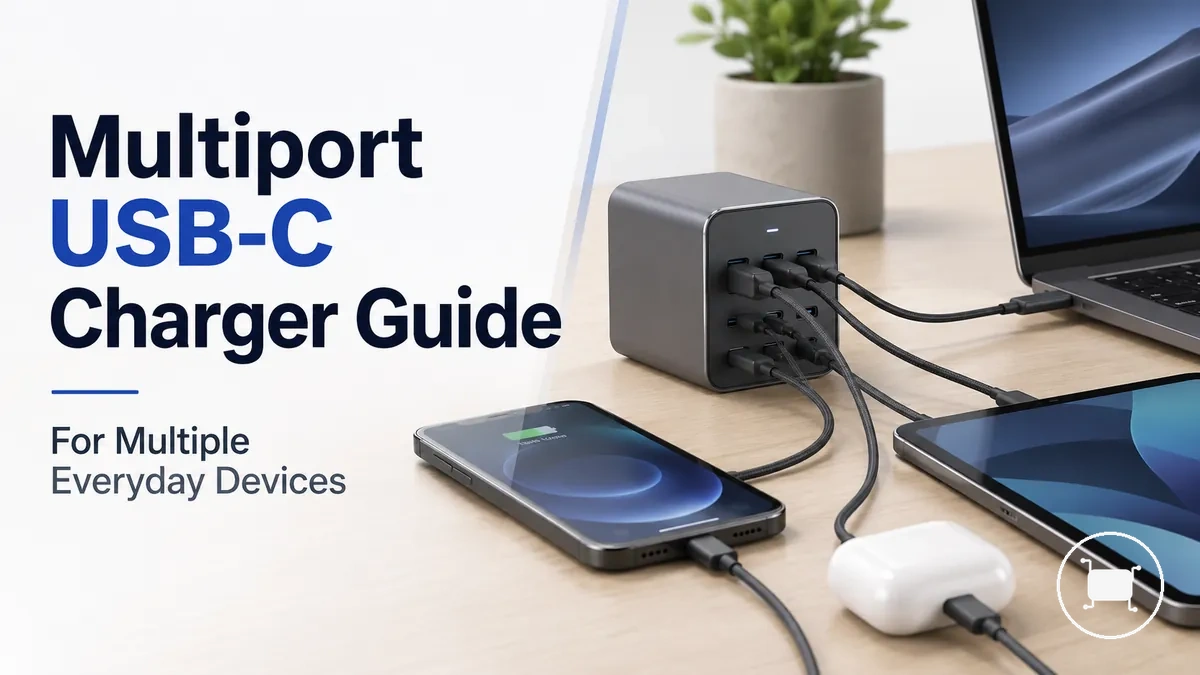
Multiport USB-C charger buying guide for multiple-device charging
A multiport USB-C charger is a charging device that powers multiple devices through several output ports, typically combining USB-C and USB-A connections in a single unit. It distributes electrical power from one source across different devices based on its internal output design and capacity. This makes it relevant for multiple-device charging setups involving phones, tablets, laptops, and accessories.
In real use, a multiport USB-C charger is often used in desk setups, travel charger scenarios, or shared charging station environments where several devices need power at the same time. In these cases, ports, wattage, device mix, power sharing behavior, and fast charging support must be evaluated together because performance can change depending on how many devices are active and how power is distributed across USB-C and USB-A outputs.
A multiport USB-C charger should be evaluated through structured buying criteria rather than relying on a single specification like port count or wattage alone. Capacity, port mix, compatibility, and form factor together determine how well the charger fits a specific multiple devices setup. These factors help define whether the charger supports stable simultaneous charging under real usage conditions.
- Capacity and wattage: Defines total available power and how it is shared across connected devices.
- Port mix: Balances USB-C and USB-A ports for different cables and device requirements.
- Device compatibility: Affects protocol negotiation across laptops, phones, and accessories.
- Form factor: Determines suitability for travel charger use, desktop charger setups, or fixed charging stations.
- Safety considerations: Relates to heat control, protection systems, and stable operation during simultaneous charging.
A multiport USB-C charger does not function as a universal-fit solution for every charging situation, since performance depends on cable limits, device mix, and power distribution behavior. Understanding these boundaries helps separate charger selection from deeper cable behavior, troubleshooting, and safety considerations.
What a multiport USB-C charger is built to do
A multiport USB-C charger is a charger built to power multiple devices through several output ports. It uses USB-C ports and often USB-A ports to deliver power from one unit to different devices at the same time. USB-C Power Delivery may be supported depending on design, allowing shared output across connected devices under simultaneous charging conditions.
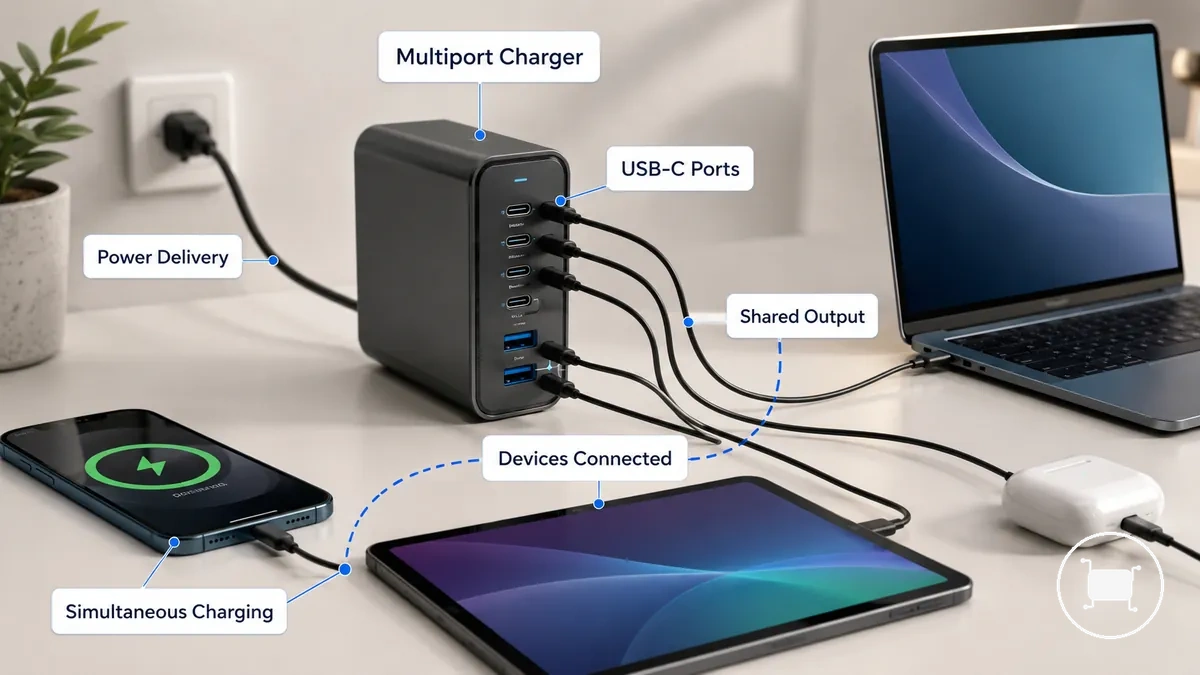
In practical use, this type of charger is placed on a desk, travel setup, or shared charging station where multiple devices need power from one source. Phones, tablets, and laptops can connect at the same time, with the charger distributing shared output across active ports. This makes simultaneous charging a core function in everyday multi-device environments.
A multiport USB-C charger is not the same as a USB-C hub, docking device, or power bank. A hub focuses on data connections, while a power bank stores energy for portable use. The charger’s function remains centered on delivering power through output ports rather than data transfer or energy storage.
Core buying factors for a multiport USB-C charger
Core buying factors for a multiport USB-C charger determine how well the charger fits a specific device mix and charging routine. A multiport USB-C charger depends on multiple buying factors working together, including wattage, port mix, USB-C and USB-A layout, device compatibility, cable limits, protocol support, size, and safety signals. The right charger fit is defined by how these criteria interact rather than any single feature on its own.
Core buying factors for a multiport USB-C charger can be grouped into practical decision areas such as power, ports, compatibility, form factor, and safety. The diagram below helps organize these buying factors so the relationship between wattage, port distribution, and device requirements becomes clearer before comparing details in a table.
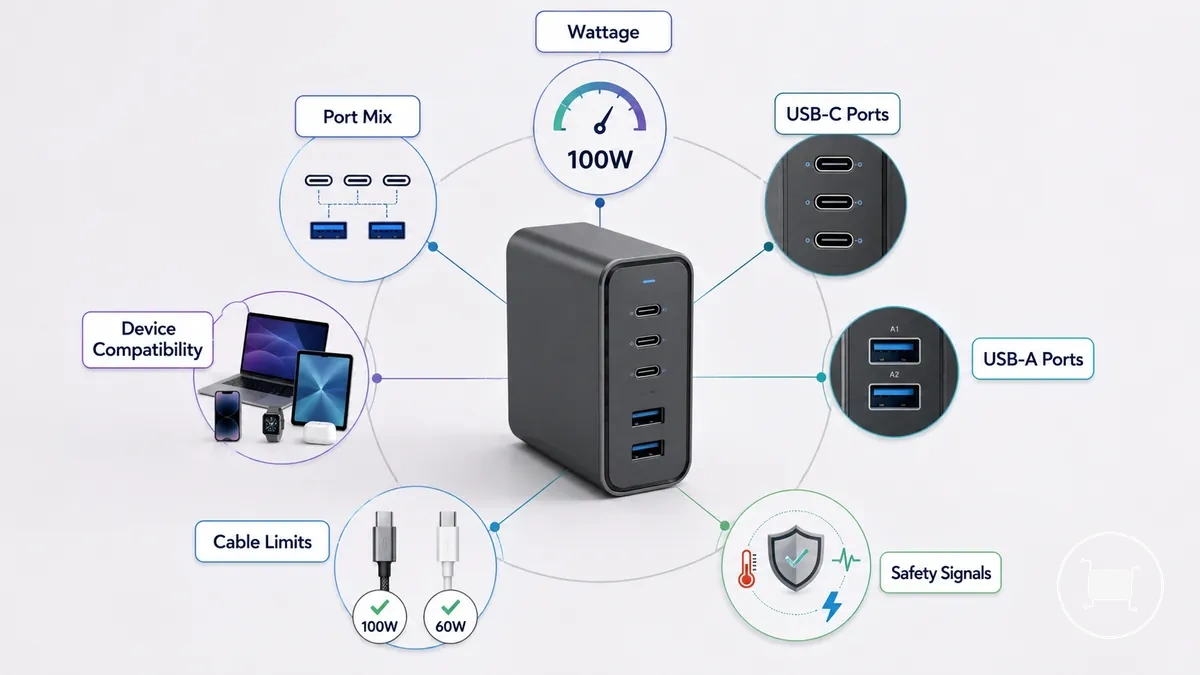
Core buying factors for a multiport USB-C charger are best evaluated by connecting each criterion to a required condition and its effect on real use. For example, wattage affects how power is shared across multiple devices, while port mix determines whether USB-C or USB-A connections match your device setup. Device compatibility and cable limits further shape whether stable charging is maintained across different devices.
| Criterion | What to check | Why it matters | When to be cautious |
|---|---|---|---|
| Wattage | Total power distribution across ports | Determines shared charging performance under load | When multiple high-demand devices charge together |
| Port mix | USB-C and USB-A availability | Affects device and cable flexibility | When devices require mixed connector types |
| Device compatibility | Support across phones, tablets, laptops | Ensures stable operation across device mix | When mixing newer and older devices |
| Cable limits | Supported cable quality and rating | Influences charging stability and protocol behavior | When using low-rated or mixed cables |
| Protocol support | USB-C Power Delivery behavior | Controls how devices negotiate charging speed | When fast charging expectations vary |
| Size (GaN) | Compact or desktop form factor | Impacts portability and heat handling | When travel and stationary use differ |
| Safety signals | Thermal control and protection design | Supports stable multi-device charging | When running sustained high loads |
In real scenarios, a compact GaN charger may suit light travel setups, while a larger desktop charger may handle multiple laptops and accessories more effectively. The same charger can perform well in one device mix and less efficiently in another depending on how wattage, ports, and cable limits align with usage patterns.
Many assumptions such as higher wattage, more ports, or GaN branding automatically improving suitability are not always accurate. A structured view of buying factors helps avoid this mistake. This is why the multiport charger buying checklist is used after understanding how each criterion affects real-world charging decisions.
Wattage range and per-port output
Wattage only matters when total output and per-port output match the connected device demand. A multiport USB-C charger depends on how wattage is split between total output and per-port output during single-device use or simultaneous load conditions, rather than the headline rating alone.
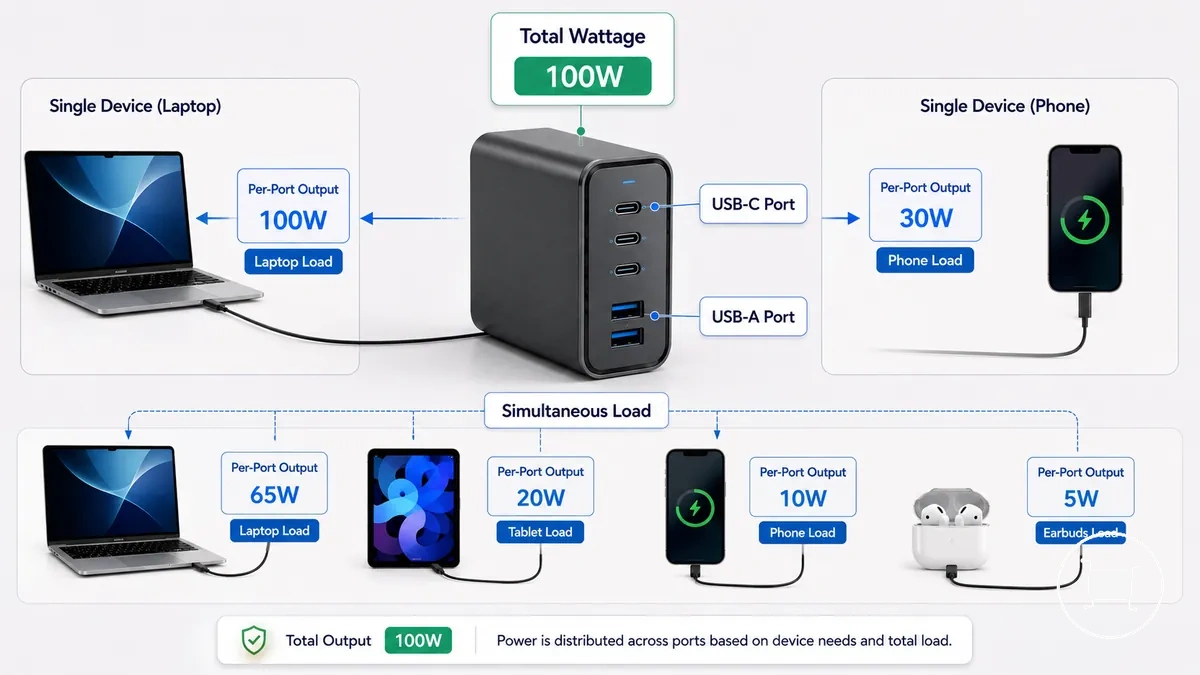
Wattage range and per-port output should be read as a shared distribution system. This helps explain how a USB-C charger behaves when one device uses a single port versus when multiple devices draw power at the same time under a simultaneous load.
| Output context | What to check | Condition that changes the result | Decision effect |
|---|---|---|---|
| Single-device charging | Per-port output availability | One device uses full port capacity | Charging speed depends on port allocation, with lower throttling risk |
| Laptop + phone | Total output vs per-port split | Simultaneous load across two devices | Charging speed may reduce due to shared output |
| Several small devices | Power distribution across ports | Multiple low-demand devices active | More balanced charging with moderate load sharing |
| High-wattage device mix | Simultaneous load capacity | Multiple high-demand devices run together | Throttling risk increases if total output is exceeded |
A laptop and phone connected to a multiport USB-C charger can show different charging behavior depending on how per-port output is divided under simultaneous load conditions. In some cases, the laptop receives reduced charging speed when the phone also draws power from the shared output system.
The concept of multiport USB-C charger wattage helps separate headline wattage from usable per-port output. Real performance depends on device demand, cable capability, and how total output is distributed across active ports.
USB-C and USB-A port mix
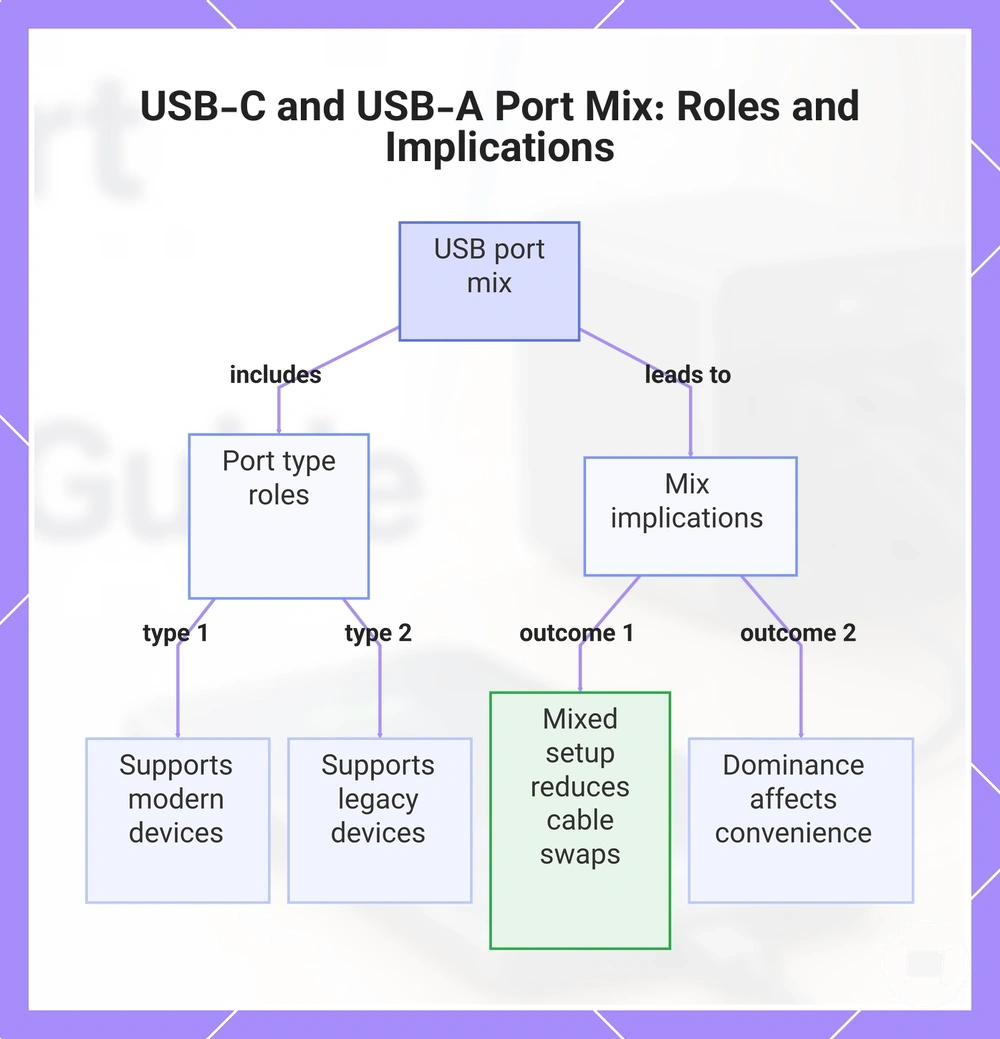
USB-C and USB-A port mix determines which devices and cables can be connected to a multiport USB-C charger. It works as a fit signal because port mix defines how USB-C and USB-A ports are distributed across a charger, alongside port count and output limit.
USB-C and USB-A port mix needs separate evaluation because each port type supports different cables, devices, and usage constraints. USB-C and USB-A roles affect how phones, tablets, laptops, accessories, and legacy devices connect under different charging conditions.
- USB-C ports: USB-C cable → supports modern phones and tablets → typically used where faster charging support is needed depending on output limit
- USB-A ports: USB-A cable → supports legacy devices and accessories → useful when older cables or peripherals are still in use
- Mixed layout: USB-C + USB-A → allows combined device support → reduces cable replacement pressure across device setups
- Port distribution: USB-C or USB-A dominance → affects real-world cable dependency → changes convenience based on device mix
A USB-C-heavy setup is usually aligned with newer phones, tablets, and USB-C cables, but may require adapters for some accessories. A mixed USB-C and USB-A setup balances compatibility for both modern devices and legacy devices, depending on available cables and charging needs.
The USB-C charger port types concept helps evaluate how USB-C and USB-A port mix interacts with port count and overall usability when selecting a multiport charger.
This chart shows how the mix of USB-C and USB-A ports in a multiport charger affects device compatibility, cable usage, and charging convenience.
Device compatibility, cable limits, and fast-charging protocols
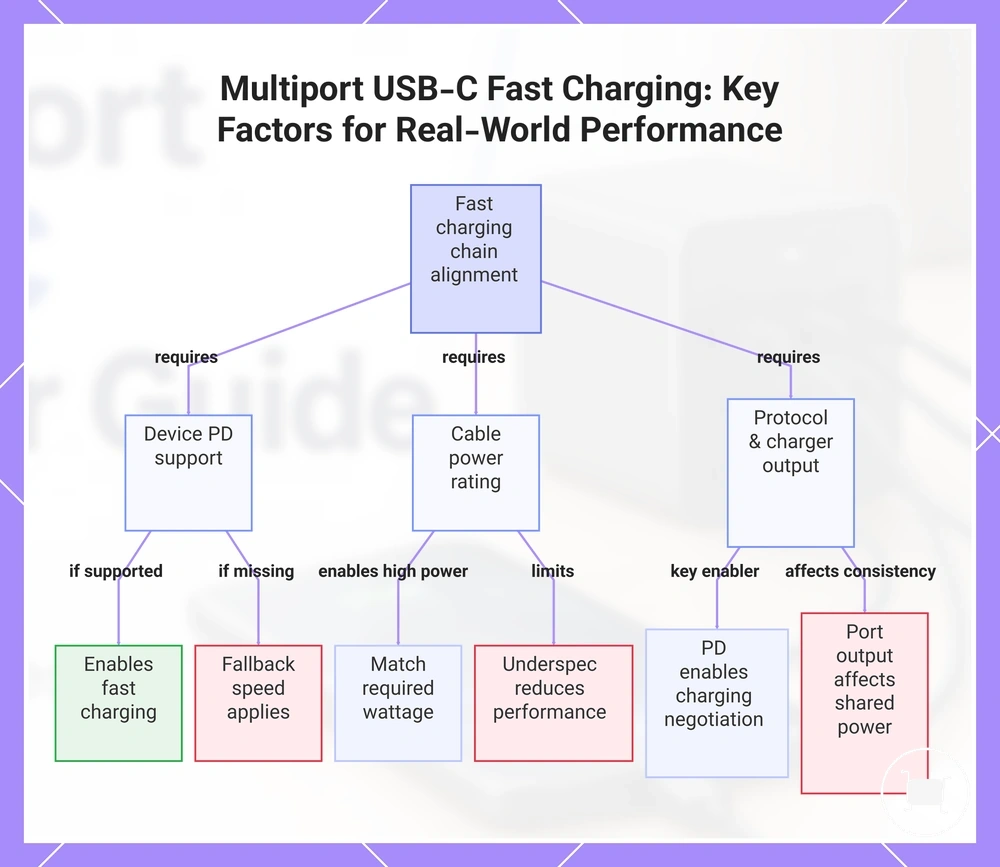
Device compatibility, cable limits, and fast-charging protocols determine whether a multiport USB-C charger can deliver fast charging in real use. Fast charging depends on alignment between charger, device, cable, and protocol, so performance is based on the full charging chain rather than a single factor.
A powerful charger may still not fast-charge every device when device compatibility or cable limits break the charging chain. USB-C Power Delivery support, USB-C cable capability, and high-wattage charging conditions must align to avoid fallback speed or reduced output during use.
- Device requirement: Device must support USB-C Power Delivery (PD) or compatible protocol → enables fast charging → otherwise fallback speed may apply
- Cable rating: USB-C cable capability must match required power level → limits high-wattage charging if underspecified → reduces charging performance
- Protocol support: USB-C Power Delivery or similar protocol → enables charging negotiation → missing support leads to standard charging
- Port output: Charger output limit affects shared power → simultaneous devices may reduce available wattage → impacts fast charging consistency
- Mismatch risk: Device, cable, or charger misalignment → prevents optimal charging negotiation → results in fallback speed
Fast charging requires coordinated support across device compatibility, cable limits, and protocol support, especially when USB-C Power Delivery is involved. When one element is not aligned, the system typically falls back to slower charging behavior.
Cable capability can change the charging result even when the charger appears suitable, making USB-C cable compatibility a key boundary factor in fast-charging performance and fallback speed behavior.
This chart shows the three main factors—device compatibility, cable limits, and protocol and charger alignment—that determine whether a multiport USB-C charger can deliver fast charging, and what happens when any factor is misaligned.
GaN design and charger size
GaN design refers to a charger technology that influences charger size and efficiency in multiport USB-C chargers. It is mainly a design signal that can enable more compact charger size and improved efficiency under high-output charging conditions, with GaN affecting how components are arranged rather than guaranteeing performance outcomes.
GaN design can change how heat behavior and port density are managed inside a compact charger. In many cases, this allows smaller form factors while supporting multiple ports, but heat behavior and efficiency still depend on load, device mix, and overall charger design rather than GaN alone.
A compact GaN travel charger is often preferred for portability and reduced size, especially when carrying multiple devices. A larger desktop charger may prioritize higher port density and more stable access to multiple connections during continuous use, where charger size supports more cable routing and sustained high-output charging demands.
- Compact travel charger: smaller size, easier portability, limited port density, typically suited for mobile setups.
- Desktop charger: larger form factor, higher port density, more stable multi-device access, typically suited for stationary high-output charging environments.
How power is shared when several devices charge at once
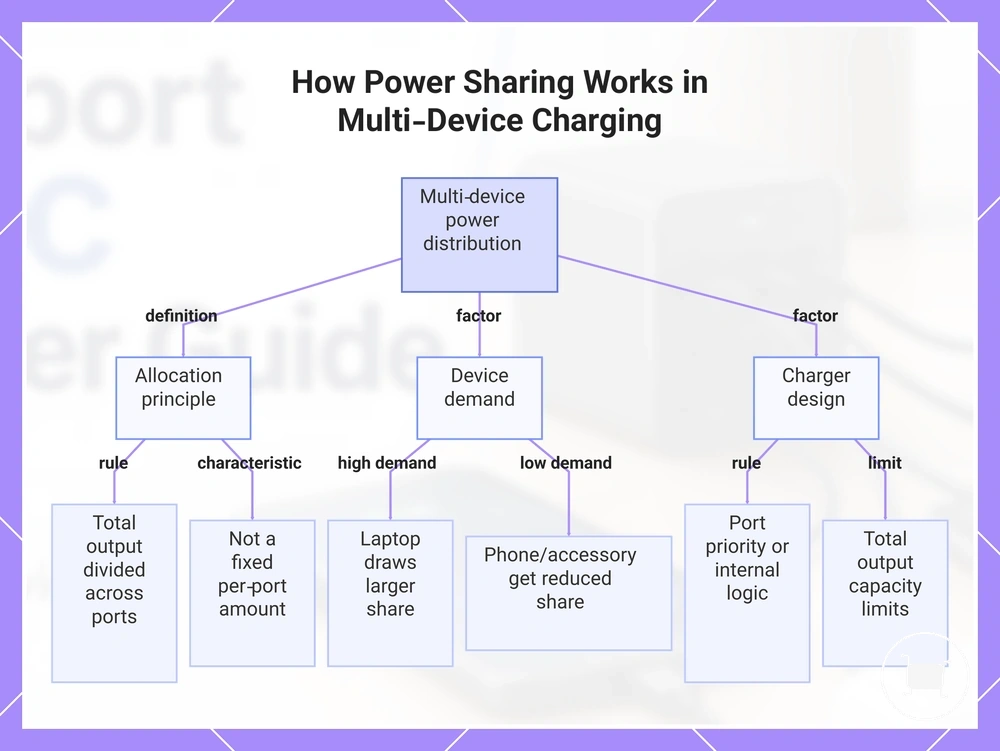
Power sharing is the way a charger divides its shared output when multiple devices are connected at the same time. During simultaneous charging, the total output is distributed across active ports, so each device receives power based on device demand and internal charging rules rather than a fixed per-port amount.
When several devices are plugged in, total output is divided across active ports, and port priority or internal allocation logic may influence how power is distributed. Device demand also changes the result, because a laptop typically draws more power than a phone or accessory, which can reduce available power for other connected devices. As a result, charging speed may change dynamically depending on how many active ports are in use at the same time.
How power is shared when several devices charge at once can be understood through a simple allocation example. In a multi-device setup, a laptop, phone, and accessory connected together may receive different portions of the shared output depending on demand and port behavior.
- Laptop: higher device demand → receives larger share of total output → charging speed adjusts based on remaining capacity
- Phone: medium device demand → receives reduced but stable share → charging speed may decrease under load
- Accessory: low device demand → receives minimal power → maintains basic charging or standby level
This distribution is not fixed and can change based on total output capacity, active ports, and internal power rules of the charger. Different chargers handle power sharing between ports in different ways, which means the same devices may receive different charging speeds depending on the charger design and load conditions.
This chart shows the main factors and rules that determine how a charger distributes power among multiple connected devices.
Matching charger capacity to phones, tablets, laptops, and accessories
Charger capacity depends on the device mix across phones, tablets, laptops, and accessories during simultaneous use. It is selected based on how different devices share charging demand rather than a single headline specification, so the device mix becomes the main decision factor.
Light setups built mainly around phones and tablets usually create lower charging demand, especially when only one or two devices charge at the same time. In these cases, cable condition and protocol support can influence stability, but the overall capacity requirement stays relatively moderate across phones and tablets.
Matching charger capacity to phones, tablets, laptops, and accessories can be understood through a device-mix matrix that maps usage patterns to charging demand. The matrix below helps translate common device combinations into capacity signals and caution points for selection.
| Device mix | Capacity signal | Compatibility condition | Buying caution |
|---|---|---|---|
| Phone-only | Low to moderate charging demand | Stable under basic protocol support | Limited expansion for future devices |
| Phone + tablet | Moderate combined demand | Requires stable simultaneous use handling | Check port availability during multi-device charging |
| Laptop + phone | Higher mixed charging demand | Depends on cable condition and protocol support | Performance may vary under simultaneous use |
| Mixed accessories | Low steady demand | Works best with balanced port allocation | Possible port congestion in compact chargers |
Laptop-plus-phone setups increase charging demand more noticeably during simultaneous use, so capacity must account for shared output behavior across active devices. In these cases, charging balance can shift depending on how power is distributed between high-demand and lower-demand devices.
Accessory-heavy setups such as earbuds, watches, and similar low-demand devices place minimal strain on charger capacity, but they still affect port availability when multiple devices are connected. These setups usually work best with stable port allocation and consistent cable condition.
Device mix determines charger capacity more accurately than any single specification. A charger may behave differently depending on whether it is used for phones, tablets, laptops, or accessories, especially under simultaneous use conditions.
Wall chargers, desktop charging stations, and travel formats
Wall chargers, desktop charging stations, and travel formats differ in how they fit location, cable reach, portability, and port access. The decision depends on form factor and how devices are used across different charging situations rather than a single physical layout.
There is a common belief that wall chargers are universally more practical, but this depends on plug placement and cable reach rather than inherent superiority. A wall charger often fits when compact plug access and flexible positioning matter, especially in spaces where portability and quick repositioning are needed for phones and small devices.
Desktop charging stations are more suitable when multiple devices stay in one place and need stable port access over time. In this setup, cable reach and desk convenience become more important because phones, tablets, and laptops may charge together in a fixed position with better organization of connected devices.
Travel formats focus on portability and compact design, which supports frequent movement between locations. The trade-off is usually reduced port access and limited cable management flexibility, especially when device mix changes during travel and plug placement varies across environments.
| Format | Strength | Trade-off | Best use case |
|---|---|---|---|
| Wall charger | Compact plug placement and flexible positioning | Limited cable reach and fewer ports | Small spaces and mobile everyday charging |
| Desktop charging station | High port access and stable multi-device use | Less portable and fixed placement required | Desk setups with multiple devices |
| Travel format | High portability and compact size | Reduced port access and limited cable management | On-the-go charging across different locations |
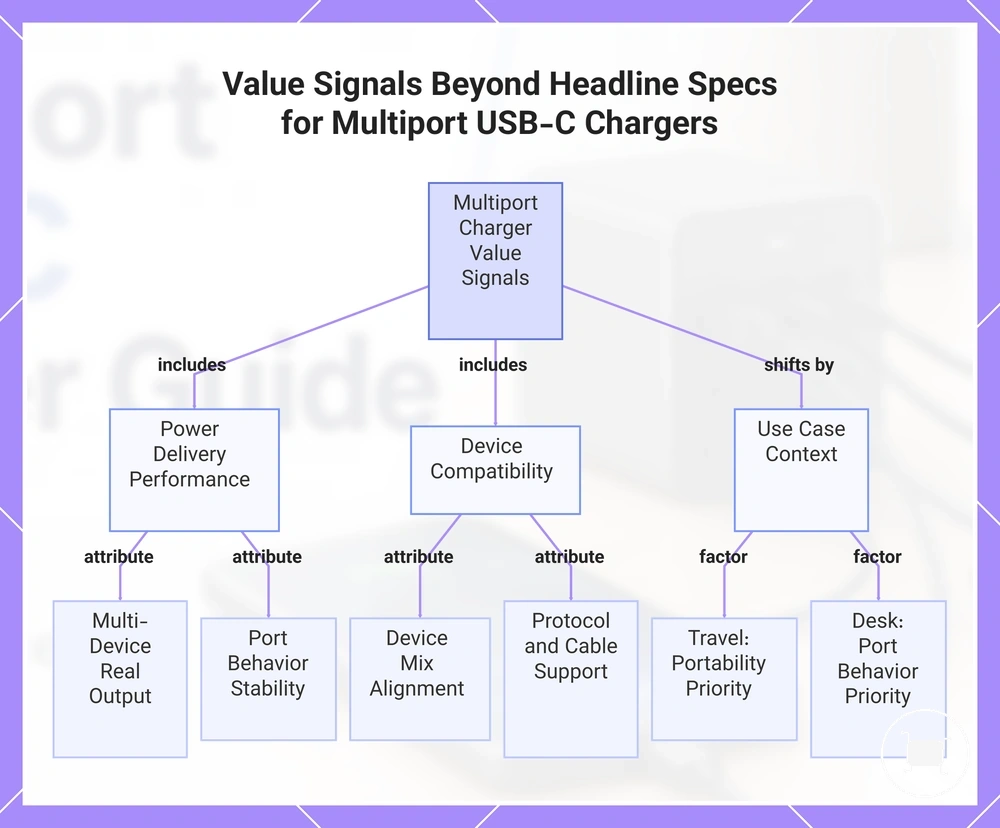
Value signals beyond headline wattage and port count
Value signals beyond headline wattage and port count describe how multiport USB-C charger value is judged through usable output, port behavior, build quality, safety signals, and real device fit rather than specifications alone. This matters because real performance often depends on how power is distributed under load, not just listed numbers, shaping value beyond headline specs. :contentReference[oaicite:0]{index=0}
Headline wattage and port count can overstate usefulness when reliable output drops under simultaneous charging or when port behavior does not match the device mix. A structured value check helps separate practical performance from surface-level specifications.
- Usable output: real delivered power under multi-device load
- Port behavior: how power is distributed across active ports
- Compatibility: alignment with device mix and charging needs
- Confidence signals: stable operation under repeated use conditions
- Portability: suitability for travel or fixed setups
- Fit for device mix: balance between phones, tablets, laptops, accessories
Protocol support and cable requirements strongly influence whether reliable output is maintained during fast charging. When USB-C Power Delivery or equivalent protocols are not aligned with cable capability, performance may drop even if headline wattage appears sufficient.
In travel use, portability becomes a stronger value signal, while in desk setups long-term usefulness depends more on port behavior and build quality under continuous multi-device charging. Different environments shift which value signals matter most.
A cheaper high-port charger may look better on paper but can underperform if port behavior reduces shared output, while a lower-port charger with stronger protocol support and stable safety signals can provide more consistent real-world value. This difference shows how value signals matter more than specifications alone before selecting a final option.
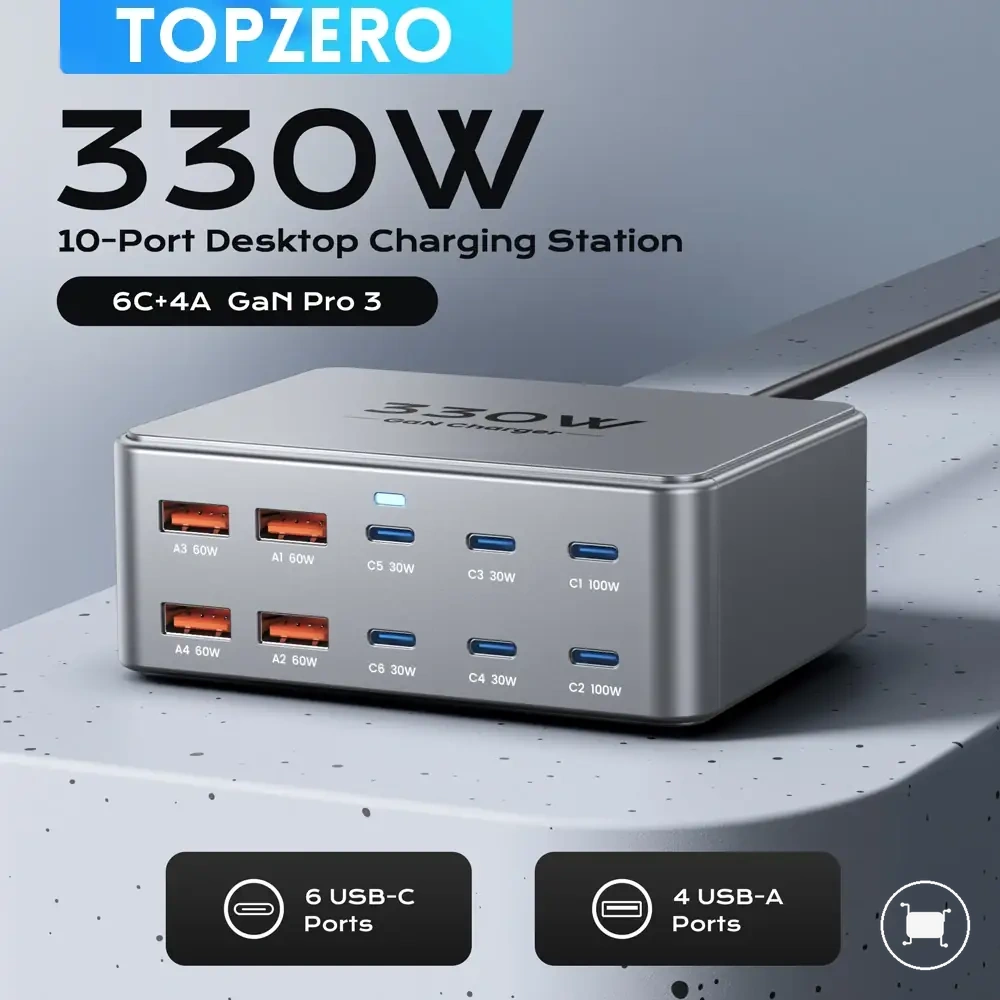
The products below are useful examples for comparing available options. Before buying, check that the compatibility criteria, key features, and product details match your needs.
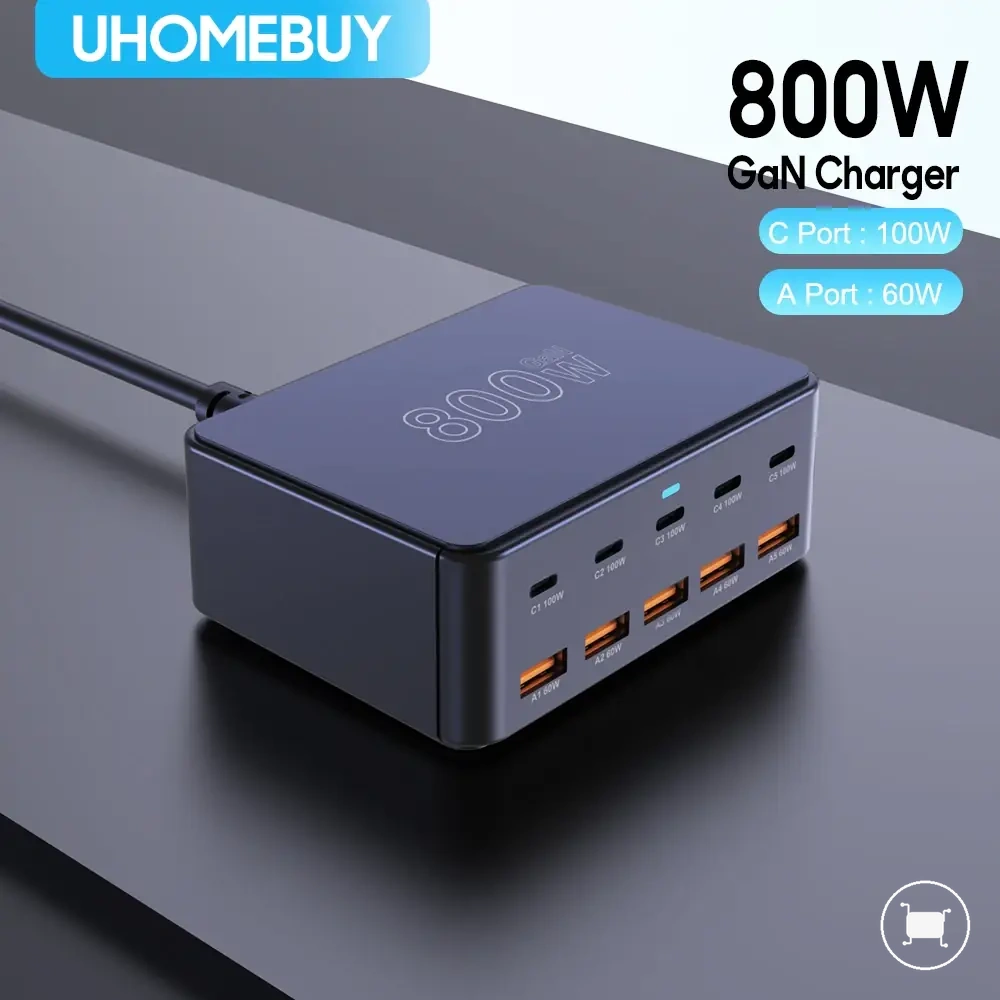
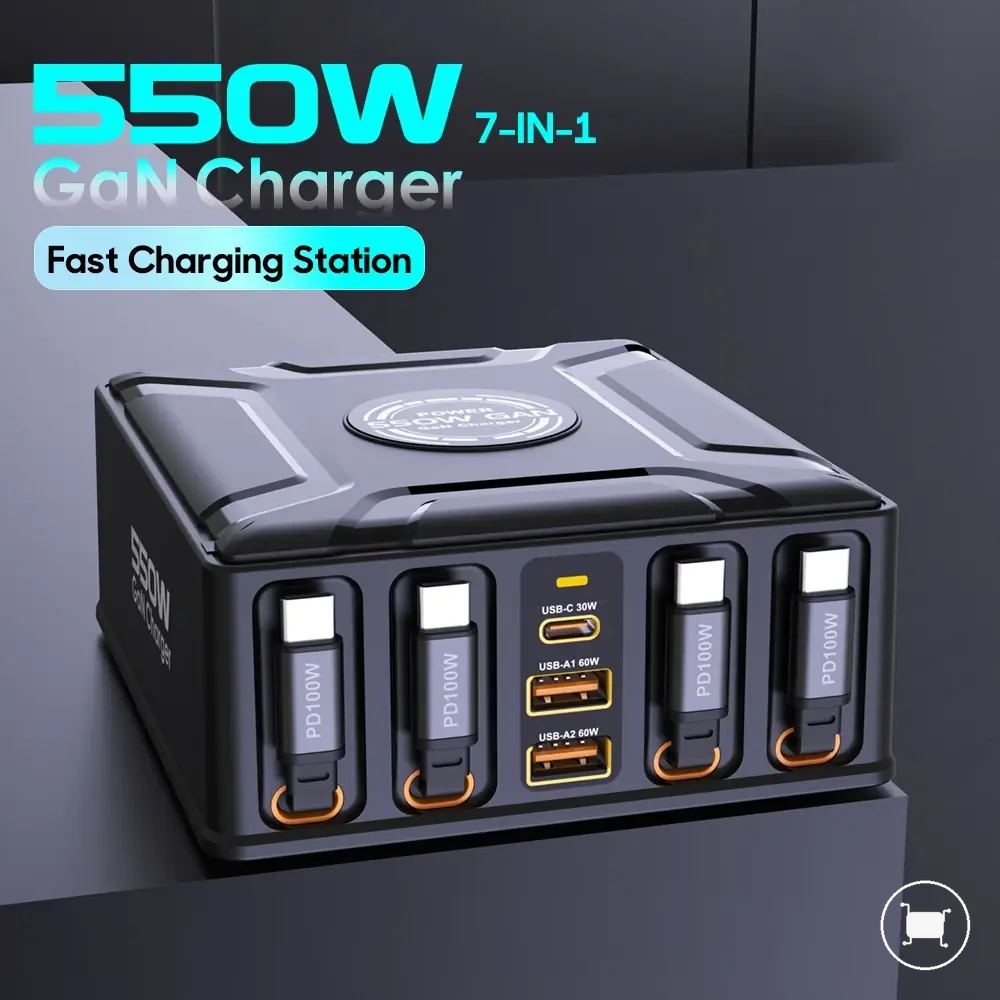
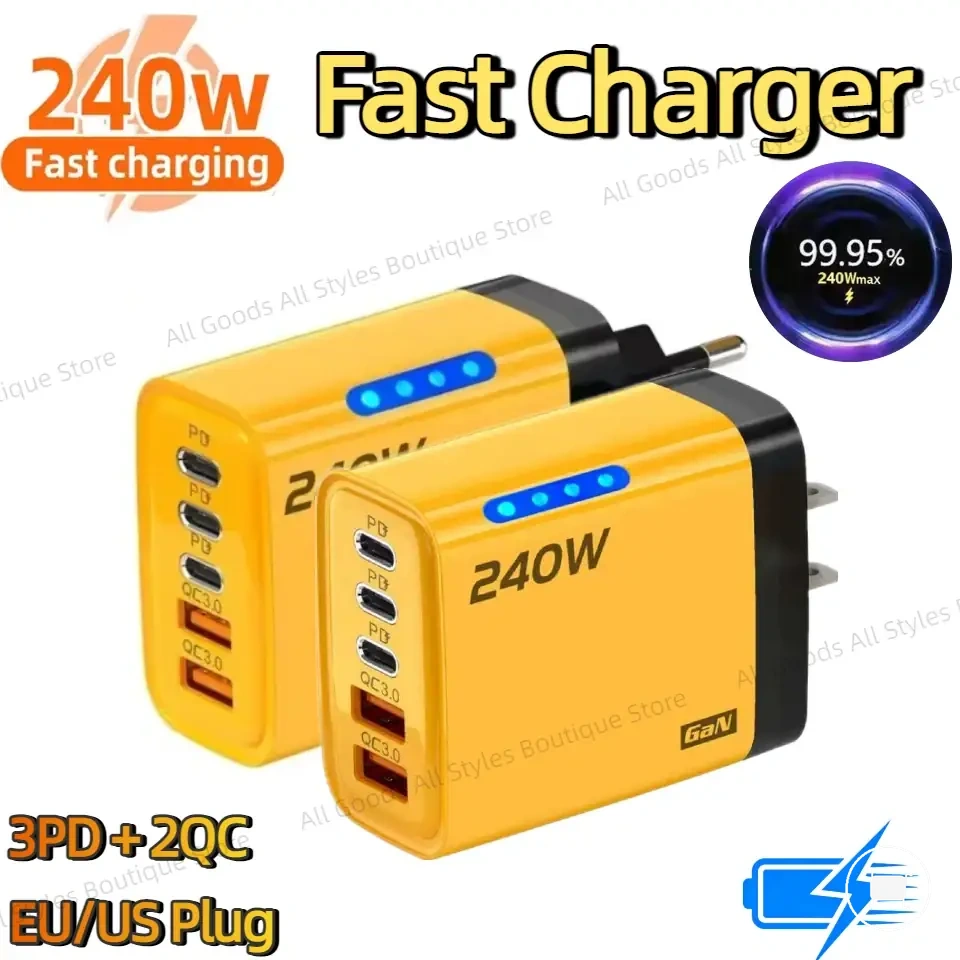
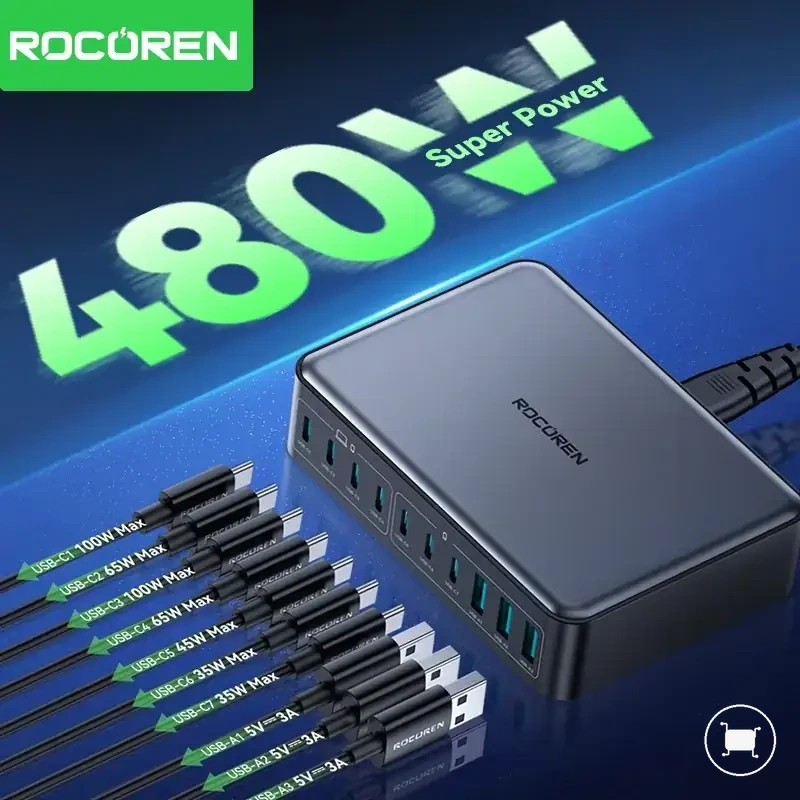
This chart summarizes the value signals that determine the real-world usefulness of multiport USB-C chargers beyond listed wattage and port count.
Safety, certification, and heat signals before buying
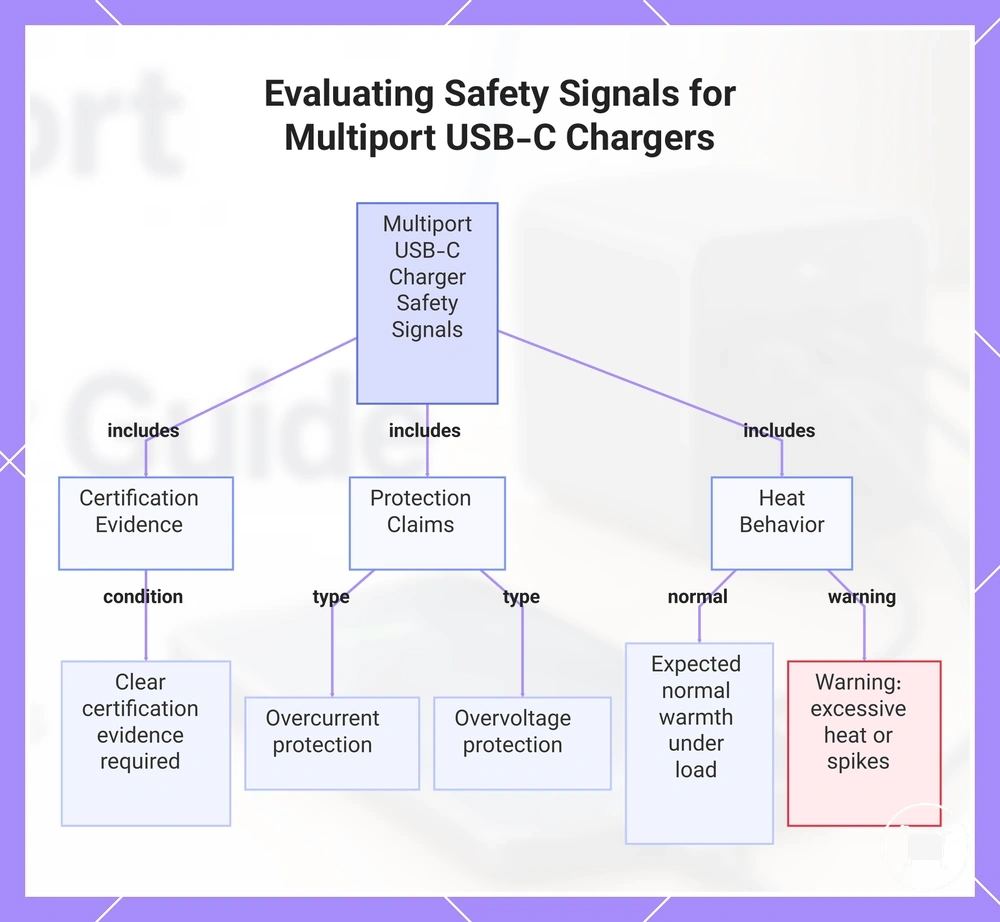
Safety signals, certification, and heat signals before buying help evaluate whether a multiport USB-C charger offers reliable protection and stable operation. These safety signals act as a buying confidence filter because they reflect how the charger handles electrical load, temperature control, and real-world usage conditions.
Certification and protection claims such as overcurrent protection and overvoltage protection should be verified before purchase because they influence risk reduction under load. Safety signals depend on clear certification evidence and valid protection claims rather than assumptions about built-in safety performance.
Safety signals can also be assessed through heat behavior in real use conditions. Temperature control and use environment affect how heat builds up during multi-device charging, especially when several ports are active or when the charger runs under sustained load.
Normal warmth can be expected during charging, particularly with multiple devices connected, while warning signs such as excessive heat, sharp temperature spikes, or unstable charging behavior may indicate a problem that needs attention. The difference depends on load, ventilation, and overall charging conditions rather than a fixed level.
Safety signals become more useful when combined with verification of certification, protection claims, and heat behavior patterns. For deeper usage guidance and precautions, refer to safe use and charging safety as a related safety boundary.
This chart illustrates the key safety signals—certification evidence, protection claims, and heat behavior—to consider when assessing a multiport USB-C charger before purchase.
When a multiport USB-C charger will not fix slow or failed charging
A new multiport USB-C charger may not solve slow charging or failed charging. The issue is often caused by the cable, device, protocol negotiation, port behavior, heat, or power sharing rather than the charger itself.
When a multiport USB-C charger will not fix slow or failed charging, separating charger choice from charging failure causes helps isolate whether the issue is external or hardware-related. The diagnostic checklist below breaks the problem into symptom, likely condition, check, and what the result means for decisions like changing the cable, device, port, or usage pattern.
| Symptom | Likely condition | Check | What it means |
|---|---|---|---|
| Slow charging on one port | Cable or protocol negotiation limit | Test a different cable or port | Fallback speed is caused outside the charger |
| Slow charging on all ports | Power sharing under load | Disconnect other devices | Total output is being divided |
| Intermittent charging | Port behavior instability | Check cable fit and connection | Connection or handshake is unstable |
| Device not charging | Device or protocol mismatch | Test device with another charger | Device limitation is likely the cause |
In some cases, a powerful charger still delivers slow charging because the cable or device cannot accept the advertised output. This creates a fallback speed situation where performance is capped by cable capability or device acceptance rather than charger capacity.
Slow charging is not always a charger fault, and failed charging often depends on protocol negotiation, port behavior, heat, or power sharing conditions. Using multiport charger troubleshooting helps separate charger selection from deeper charging causes.
Q: Can a new charger fix all slow charging issues?
A: No. It may help when the charger is the limiting factor, but cable, device, or protocol negotiation can still restrict speed.
Q: Why does fast charging drop even with a high-wattage charger?
A: Because cable limits or device support may restrict power acceptance, causing fallback speed despite higher charger capacity.