
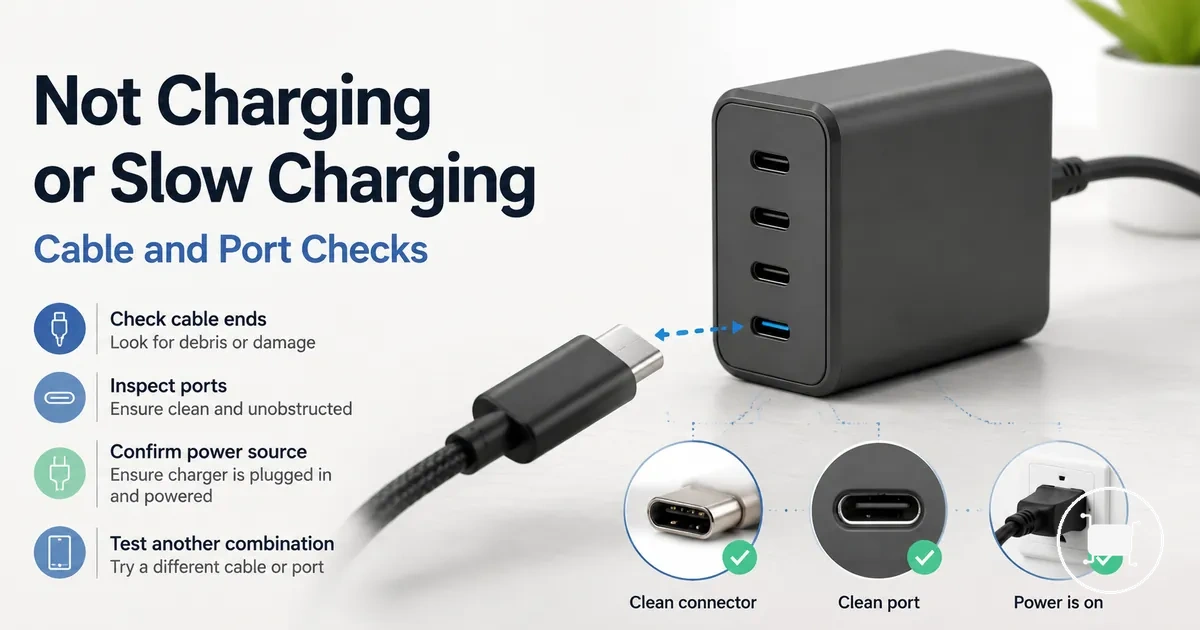
Multiport USB-C Charger Charging Problems
When a multiport USB-C charger is not charging, cuts in and out, or is charging slowly, the likely cause usually sits in the USB-C cable, charger port, power source, connected device, shared wattage, or USB-C negotiation path. The charger may still be working while one surrounding part limits power output or prevents a stable charging connection. Symptom separation is the first diagnostic move.
Multiport USB-C charger charging problems are charging failures where the charger, cable, port, device, or power path does not produce the expected charging result. This can look like no response, a slow charge, a charging icon that appears and disappears, or one device charging while another does not. A charger failure is only one possible direction, because cable capability, port condition, connected load, and device protocol support can create similar symptoms. For broader buying and entity context, use the multiport USB-C charger guide.
To avoid a mistaken replacement decision, group the charging problems by what changes and what stays the same. If one USB-C cable fails across ports, the cable may be the limiting part; if one charger port behaves differently, port contact or port output may need checking; if only one connected device fails, device demand or protocol support may be involved. If multiple devices charge slowly at the same time, shared wattage or USB-C negotiation may be part of the path. The next section should move from symptoms to checks.
If there is heat beyond normal warmth, visible damage, a burning smell, or other safety signs, treat the issue as a stop-use condition before continuing diagnosis. Do not keep testing a multiport USB-C charger, cable, plug, or power source that shows damage or unsafe behavior.
Charging Symptoms That Narrow the Cause
When a charging symptom appears, the likely cause is often easier to narrow down by observing what the charger and device actually do. A charging symptom is a diagnostic clue, not a final answer. Visible behaviour narrows the next check.
Charging Symptoms That Narrow the Cause helps separate what you see from what may be causing it. The image below labels the charger, cable, port, and device variables that can help classify no power, intermittent charging, and slow charging.
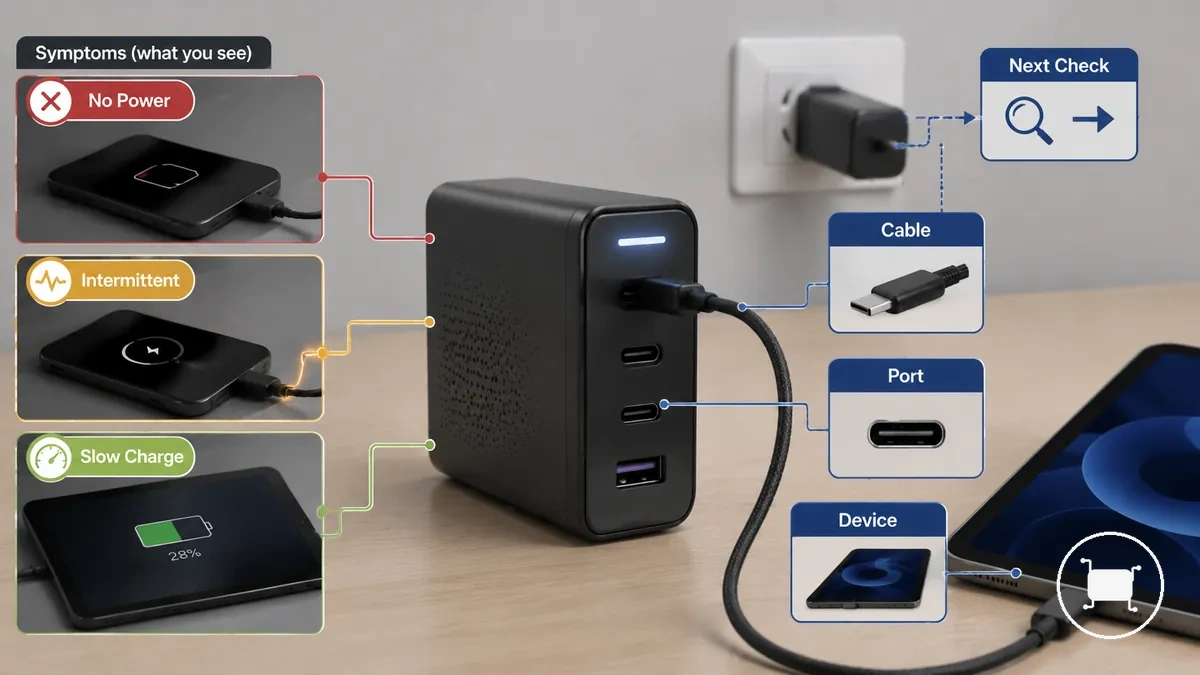
If the same charger behaves differently across devices or ports, the charging behaviour may point toward a specific test rather than a charger replacement decision. A device-specific result, a one-port-only result, or a cable-dependent result can change the diagnostic direction. These symptoms are clues rather than final causes.
| Symptom | Likely condition | First check | What it means |
|---|---|---|---|
| No power | Power path may be interrupted | Check outlet, cable, and device response | The symptom shows that power may not be reaching the device, but it does not identify the failed part. |
| Intermittent charging | Loose contact or unstable connection may be present | Observe port movement and cable angle | The charging behaviour changes during use and may indicate a connection-related fault pattern. |
| Slow charging | Shared output, battery state, or device demand may be affecting charge speed | Compare charging behaviour under different device loads | The device is receiving power, but charging performance may be limited by conditions rather than a charging failure. |
| One-device-only charging | The condition may be specific to the connected device or cable | Cross-test with another device or cable | A different result across devices can help narrow the diagnostic path. |
| One-port-only charging | The affected port may require closer inspection | Test the same device and cable on another port | A port-specific result helps separate a charger-wide issue from a single-port condition. |
No Power From the Charger
When no power happens, the power path may be interrupted somewhere between the power source and the device. No visible charging response, such as a charging icon, no LED activity, or no vibration, can result from the charger brick, wall outlet, USB-C cable, plug seating, or device response. No power is different from slow or intermittent charging because there is no visible sign that charging has started.
No Power From the Charger can look identical across different causes, and the image below helps clarify which parts should be checked first. It labels the outlet, cable, and device involved in the no-power symptom.
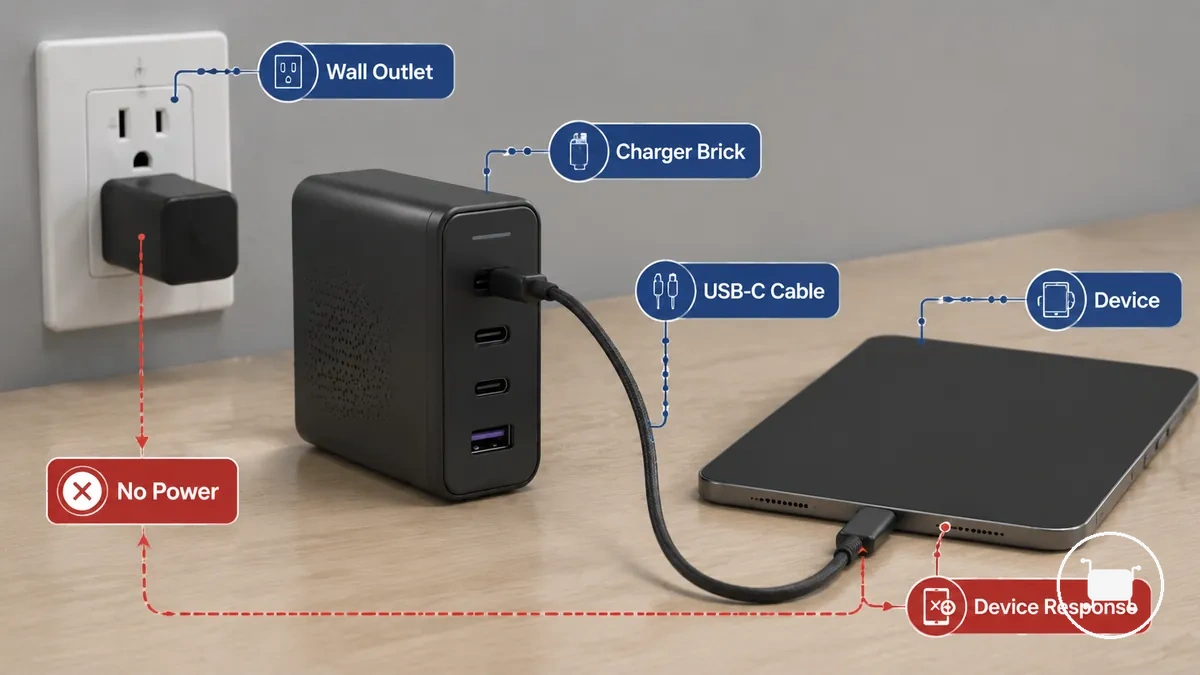
If no power continues, isolate each variable before considering replacement:
- Test the wall outlet with the same power source to confirm the outlet is supplying power.
- Check plug seating at both the charger brick and outlet to ensure the connection is fully inserted.
- Swap the USB-C cable to rule out a continuity issue or poor connector fit.
- Observe the device response for any charging icon, LED activity, or vibration when connected.
- Repeat the test with a known-good charger, cable, and the same device to compare the result.
If the symptom remains unchanged after these checks, the charger brick may be involved, but only after outlet, cable continuity, and device response variables have been separated. The safest next check before replacement is to repeat the test with a known-good setup and compare the outcome.
Intermittent Charging or Cutting In and Out
When intermittent charging happens, an unstable connection may be causing the device to connect and disconnect repeatedly. The charging icon may appear and disappear, or charging drops may occur during use. Intermittent charging or cutting in and out should usually be checked for contact stability before making wattage assumptions.
Intermittent Charging or Cutting In and Out often relates to connector fit, cable position, or port contact changes. The image below highlights the cable angle, port contact, and movement-related conditions that can help diagnose repeated reconnect behaviour.
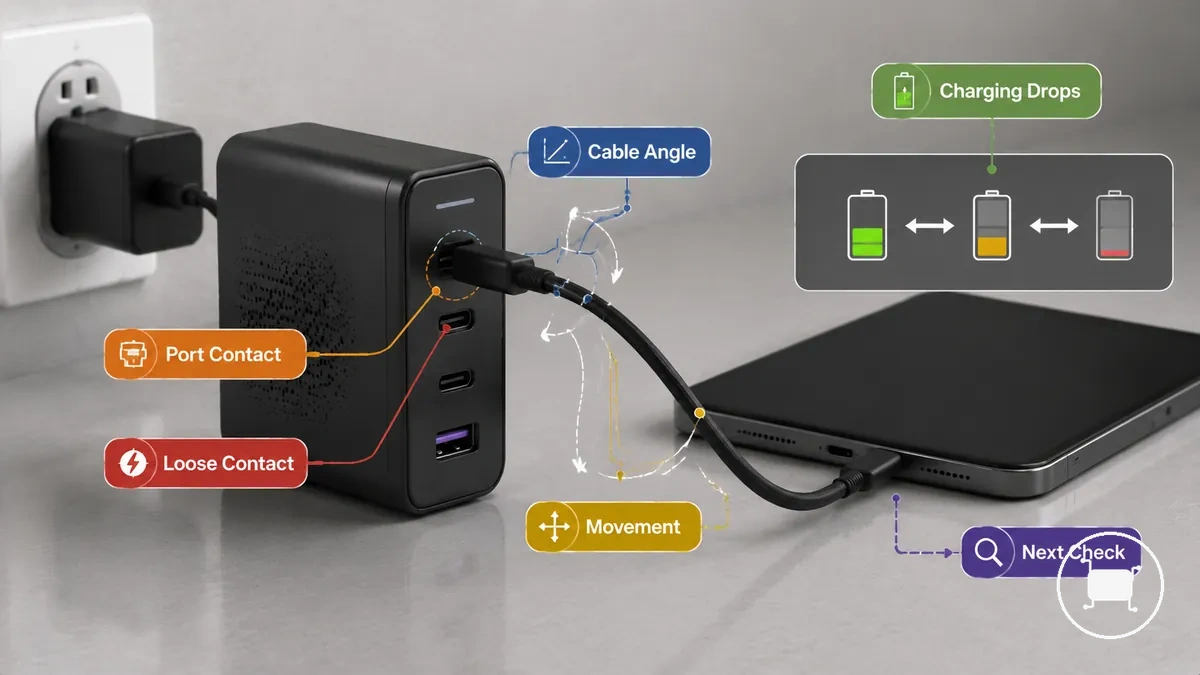
If charging connects and disconnects repeatedly, use these local checks to narrow the cause:
- Check for movement sensitivity by observing whether charging changes when the cable angle changes.
- Look for port looseness, seating issues, or wobble that may create a loose contact.
- Inspect for cable strain near the connector, which may affect connector fit during use.
- Repeat the connection test with the same device and cable position to see whether the behaviour repeats consistently.
If the symptom continues, port debris, a loose contact, or a negotiation reset may be involved when the connection repeatedly reconnects. A device state change may also contribute to charging drops in some cases. This type of unstable charging is different from normal shared-output redistribution under a multi-device load because the connection itself repeatedly cuts in and out.
Slow Charging Despite a Connected Cable
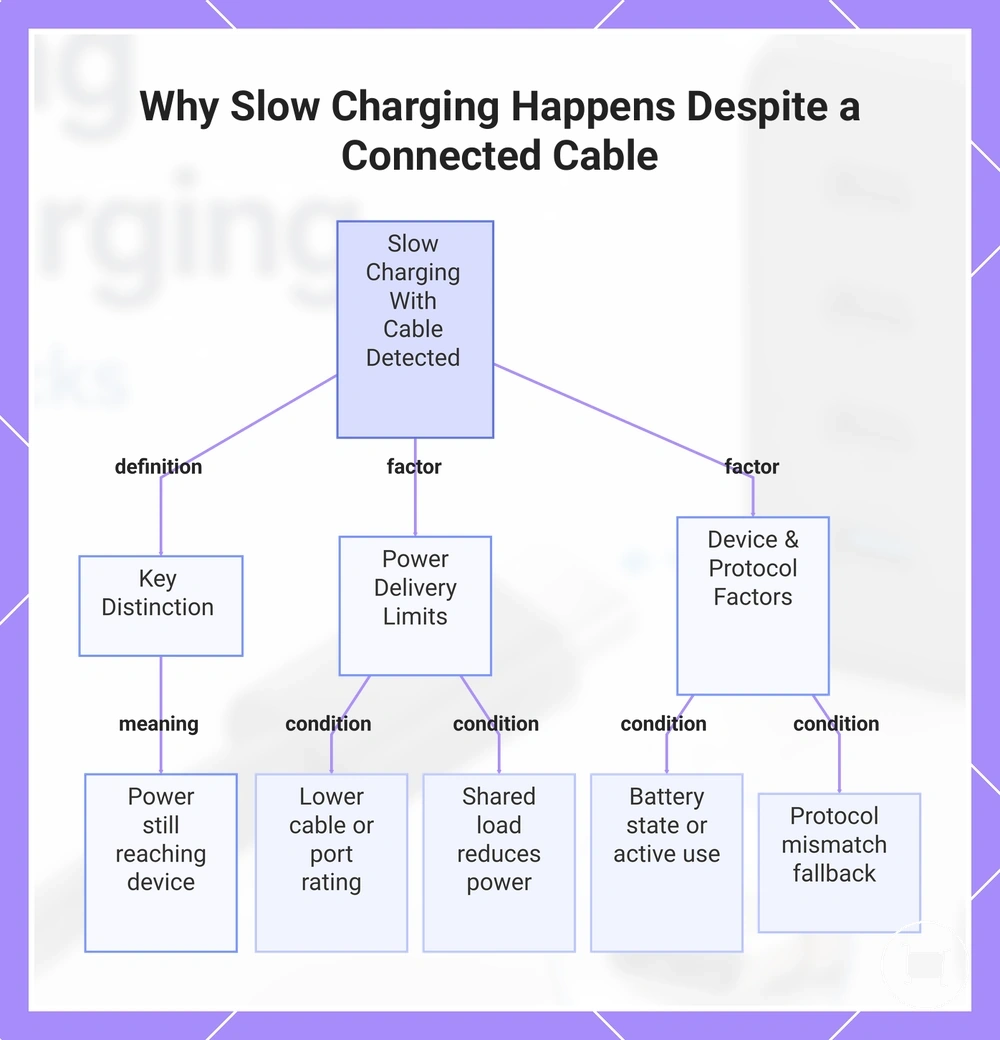
When slow charging happens, one condition may be limiting available power even though the connected cable is detected and charging has started. Slow charging is different from no charging because power is still reaching the device. A connected cable does not guarantee full power.
When slow charging needs to be classified, the next step is to identify which condition may be limiting charging speed. The following conditions can contribute to reduced charging speed without stopping charging completely:
- A lower cable rating may limit available power even when the connected cable appears to work normally.
- A low-output port may provide less available power than another available charging port.
- A shared load across multiple connected devices may reduce the power available to each device.
- A device battery state or active use may contribute to slower charging under certain conditions.
- A protocol mismatch may trigger fallback charging behaviour that results in reduced charging speed.
These conditions can produce slow charging while maintaining an active connection. The exact cause depends on the cable rating, port output, shared load, battery state, and USB-C negotiation behaviour. A deeper analysis of power limits and shared-output conditions belongs in the later power-limit section.
This chart shows the definition of slow charging and the main conditions that limit charging speed even when a cable is connected.
Cable, Connector, and Power Source Checks
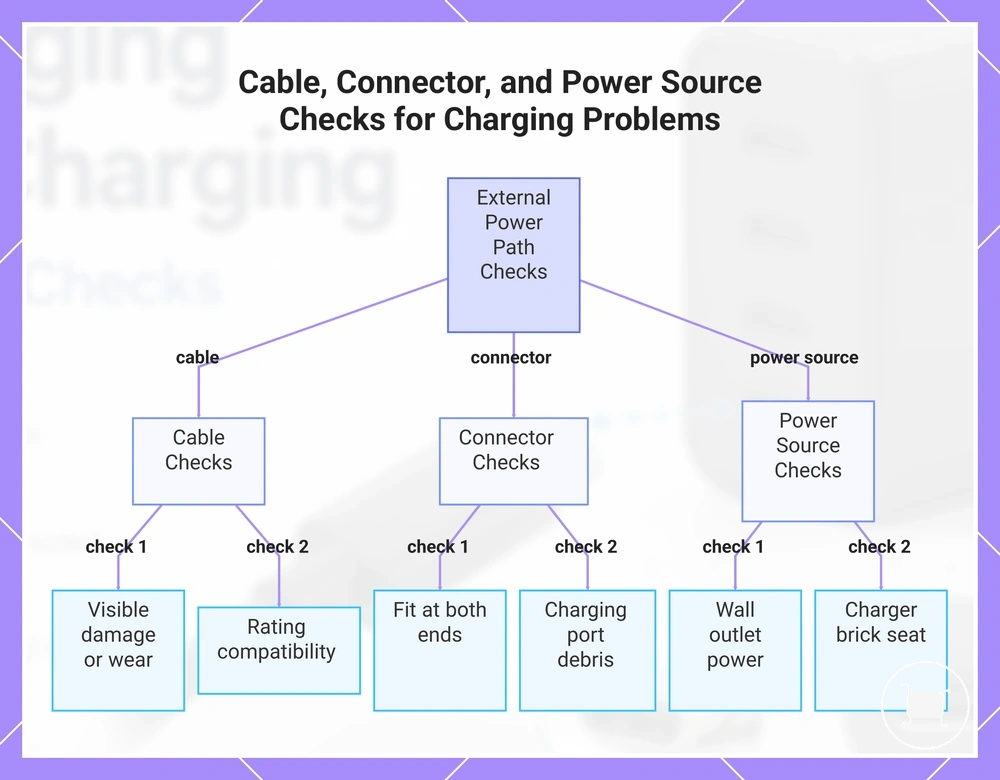
When charging problems appear, the fastest way to narrow the cause is to verify the external power path before exploring deeper compatibility or charger-failure possibilities. A failed physical or power-source check can explain the symptom, while a passed check helps eliminate a false lead. These external checks prevent false positives.
Start with this checklist to verify the most common external variables. Each item helps eliminate one possible issue involving the cable, connector, or power source.
- Check the cable for visible damage, excessive bending, or worn connector ends. If damage is present, stop the sequence and test with a known-good cable before continuing.
- Verify that the cable rating is appropriate for the connected devices. If charging behaviour changes with another cable, continue testing from that result.
- Check connector fit at both ends of the connection. If the connector feels loose or does not seat fully, stop and verify the connection before moving to other checks.
- Inspect the charging port for visible debris that may affect contact or seating. If debris is suspected, avoid invasive cleaning methods and continue only after the connection can be checked safely.
- Verify that the wall outlet is supplying power. If the outlet fails with other devices, stop the charger test and investigate the power source first.
- Check any power strip in the charging path. If bypassing the power strip changes the result, continue testing from the direct wall outlet connection.
- Confirm that the charger brick is fully seated in the wall outlet or power strip. A loose plug fit can interrupt the power path even when the charger appears connected.
If a check fails, address that condition before moving further into diagnosis. When all cable, connector, and power source checks pass, continue testing because the cause may involve factors beyond the external power path. Stop testing if a damaged outlet, plug, adapter, or similar power component presents a safety concern.
This chart shows the three main check groups for verifying the external power path when charging problems occur, helping to quickly narrow the cause before deeper diagnosis.
Cable Damage, Cable Rating, and Connector Fit
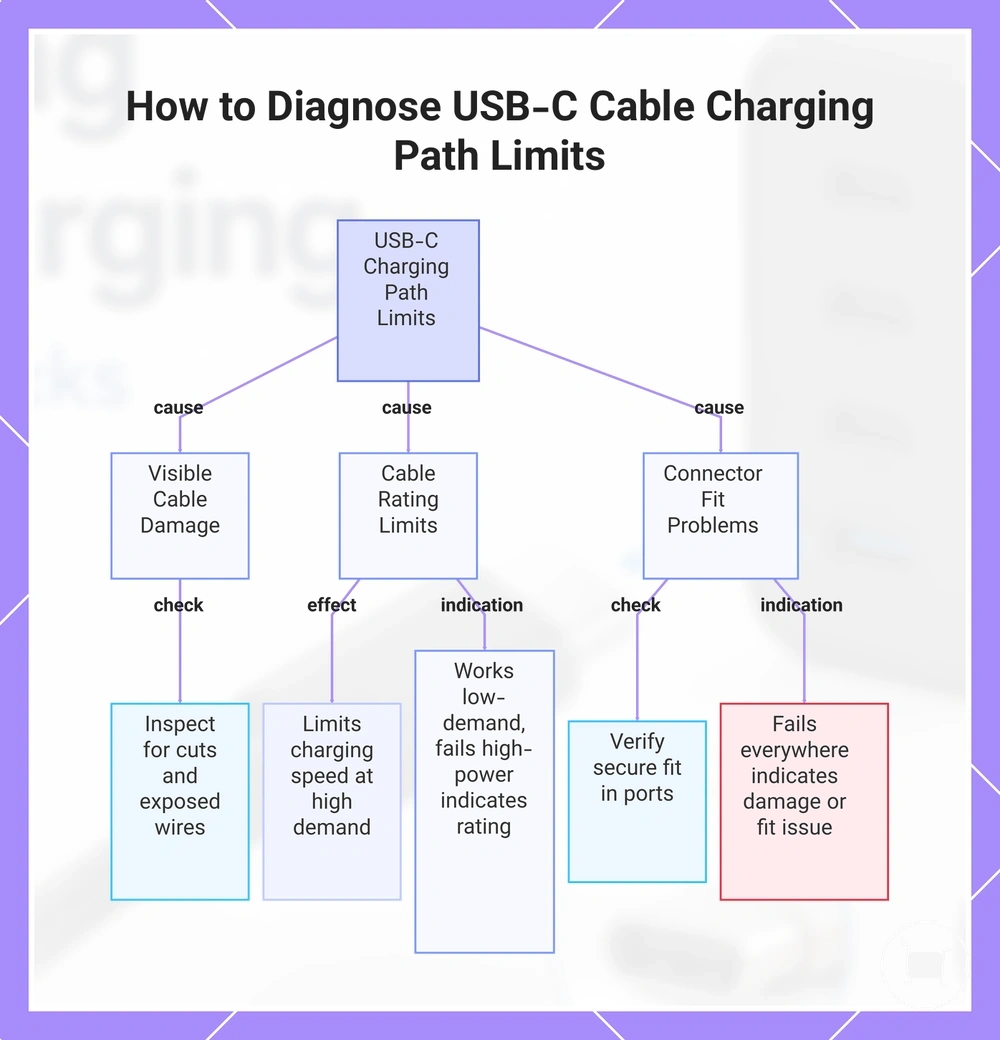
A USB-C cable can be connected and still prevent normal charging when cable condition, cable rating, or connector fit limits the charging path. Visible cable damage can interrupt charging, while cable capability may affect charging performance under certain conditions. A present cable can still be the limiting part.
When charging behaviour suggests a cable-related issue, use a focused compatibility check to separate physical faults from capability limits:
- Check for visible cable damage, including cuts, exposed sections, or worn connector surfaces.
- Inspect each connector for a bent end, loose end, or poor connector seating.
- Verify that connector fit is secure in both the charger port and device port.
- Consider whether cable rating may be limiting charging speed when device demand is higher.
- Observe whether charging behaviour changes when the same device is tested with another USB-C cable.
- Check whether charging issues appear only with higher-power devices, which may indicate a cable capability or high-wattage support limitation.
If a cable fails everywhere across multiple devices and chargers, cable damage or a connector fit problem may be involved. If a cable works with lower-demand devices but shows slow charging or charging problems with a higher-power device, cable rating or high-wattage support may be part of the compatibility check rather than a physical fault. For a broader evaluation of cable-related conditions, see cable compatibility checks.
This chart identifies the three main cable-related causes of charging problems and shows the key checks and diagnostic clues to distinguish physical damage from rating limits.
Dust, Debris, and Loose USB-C Port Contact
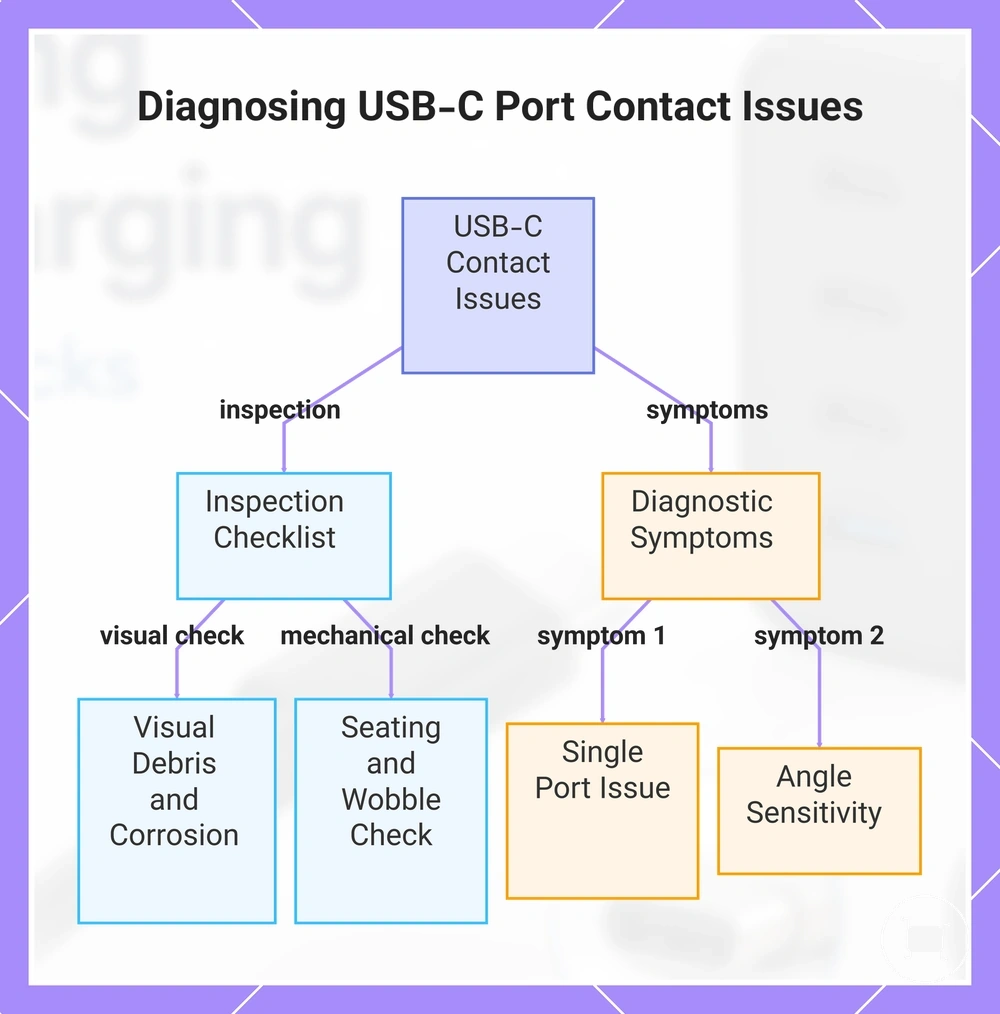
Dust, debris, and a loose USB-C port can affect charging even when the charger and cable appear functional. Lint, poor connector seating, or a loose connection may interrupt the charging path and create symptoms that resemble charger failure. The diagnostic focus is poor contact.
When charging behaviour suggests a port-contact issue, start with a careful inspection rather than a repair attempt. Use the checklist below to assess visible conditions and connector stability:
- Inspect the USB-C port for visible dust, lint, or debris that may affect connector seating.
- Check whether the connector seats fully or feels blocked during insertion.
- Observe whether the connector shows unusual wobble or loose movement while connected.
- Look for visible corrosion signs or other obvious contact-related changes inside the port.
- Caution: Stop inspection if the port appears damaged or if further checking would require invasive repair.
If charging problems occur on only one port, a port-specific failure or loose USB-C port contact may be involved. If charging changes when connector position or cable angle changes, poor contact or connector wobble may be affecting port behaviour. For additional criteria when comparing one-port and multiport results, see port behavior checks.
This chart shows the key inspection steps and symptom patterns for identifying poor USB-C port contact as a cause of charging problems.
Wall Outlet, Power Strip, and Charger Brick Checks
When a USB-C charger appears dead, the cause may be an upstream power issue rather than a charger fault. A wall outlet, power strip, charger brick, or adapter can interrupt power before charging begins. In these cases, the charger may not be receiving usable input.
When charging does not start, verify the wall outlet, power strip, and charger brick connection before assuming the charger is faulty:
- Test the charger with a different wall outlet to confirm that the power source is available.
- Check whether a power strip switch is turned on and supplying power.
- Verify plug seating at the wall outlet and charger brick, especially if a loose plug is present.
- Inspect any removable charger cable for a secure brick connection and power input fit.
- Check whether an adapter is seated correctly and does not shift during normal use.
- Look for visible damage, unusual heat, or wear on the outlet, plug, adapter, or charger brick.
If these checks pass, the charger may require further diagnosis rather than immediate replacement. Stop using any damaged outlet, loose plug, adapter, or charger brick that shows visible damage or excessive heat.
One Device, One Cable, or One Port Charging Failures
When a charging failure appears, cross-testing helps isolate the source before a replacement decision is considered. A repeated result across controlled tests can show whether the fault follows one device, one cable, one port, or the charger body. The key diagnostic rule is to identify the variable that follows the fault.
A test matrix is the most direct way to isolate a charging failure. Repeat the same charging test while changing only one variable at a time, then compare the repeat result. This approach reduces confusion because only one variable changes at a time.
| Test result | Likely direction | Check next | Boundary note |
|---|---|---|---|
| One device fails while other devices charge | Device-only issue or device-specific condition may be involved | Cross-test the same device with another charger and cable | A different result on another setup may change the diagnostic direction. |
| One cable fails across multiple devices | Cable-following fault may be present | Repeat test with another cable and compare connector fit and cable rating | A repeat result strengthens the cable-focused diagnosis. |
| One port fails while other ports charge normally | Port-only issue may involve port contact, port output, or port behavior | Test the same device and cable on another port | The result should stay with the same port to support this direction. |
| One outlet causes charging problems | Power source condition may be affecting charging | Test from a different wall outlet | The charger may not be the primary variable when the result changes with the outlet. |
| All devices fail across all ports | The charger body or upstream power path may require closer evaluation | Repeat the test using a known-working setup and power source | This result points more broadly than an isolated failure. |
If one device produces a different result while the charger works with other devices, the charging failure may be following that device rather than the charger. If one cable or one port repeatedly produces the same outcome across tests, the fault may be following that variable. If all devices fail under the same test conditions, the charger body becomes a more likely direction, although the result still depends on a repeatable test outcome.
Device-Specific Power Requirements
A charger may work for one device but not another when device-specific power requirements differ. The same output can be enough for a phone or accessory but limited for a tablet, laptop, or handheld with higher device demand. Device demand can change the result.
If one device charges slowly or does not start charging while another device works, compare the device need against the charger output before assuming the charger has failed. A phone may charge differently depending on battery state and fast-charging behaviour, while a tablet or laptop may need more available wattage than a smaller accessory. A low-power accessory may accept lower output or fallback behaviour, but a higher-demand device may show slow charging or no stable charge. The symptom may reflect insufficient wattage, while a complete failure to start may point toward a negotiation failure under that device condition.
Port Rotation and Cross-Device Testing
When a charging problem appears inconsistent, port rotation and cross-device testing can help isolate the failing variable. The goal is to compare repeat results while keeping the test controlled. Only one variable must change per test.
If the same charging problem appears across multiple tests, record each test result before changing another condition. A repeated pattern may indicate direction, but interpretation depends on whether the fault follows a cable, stays with a port, appears on one device, or changes with an outlet. The result may suggest whether the fault follows a cable, port, device, or outlet.
- Change the cable and keep the same port, device, and outlet unchanged. Record whether the charging problem remains or disappears. If the same problem follows the cable during a repeat result, a cable-following fault may be involved.
- Change the port and keep the same cable, device, and outlet unchanged. Record whether the charging problem stays with one port. If the repeat result remains on the same port, a port-related issue may be involved.
- Change the device and keep the same cable, port, and outlet unchanged. Record whether the charging problem appears only with one device. If another device charges normally, device-specific demand or behaviour may affect the result.
- Change the outlet and keep the same charger, cable, port, and device unchanged. Record whether the charging problem changes with a different power source. If the result changes, the outlet or power source may be contributing to the failure.
- Repeat the test that produced the clearest result and keep all other conditions unchanged. Record whether the same pattern appears again. A repeat result provides a stronger basis for interpreting which variable the fault follows.
USB-C Power Negotiation and Protocol Mismatch
USB-C power negotiation can fail when the charger, cable, and device do not share a supported power level. The charger may advertise one charging capability, while the cable or device may only support another. Normal charging depends on charger-cable-device agreement.
USB-C power negotiation is the process where the charger and receiving device establish usable charging behaviour through the connected cable. PD or PPS support may affect whether fast charging is available, but each part still needs compatible protocol support. If the supported power level or advertised power does not align, the system may fall back to a lower charging mode. In some cases, fallback charging may still work, but it may be slower or device-specific.
When a protocol mismatch is suspected, separate the source, cable, device, and charging outcome before assuming a charger fault. The table below organizes source charger, cable capability, receiving device, and possible outcome.
| Component | Attribute checked | Condition | Possible charging outcome |
|---|---|---|---|
| Charger | Protocol support | PD or PPS support may not match the receiving device | Fast charging may not start, or charging may fall back |
| Cable | Cable capability | The cable may not support the advertised power needed for the device | Charging may be slow or limited |
| Device | Device requirement | The device may require a supported power level the charger does not provide | The device may charge slowly or not start charging |
| Fallback behaviour | Fallback charging | The parts may agree on a lower supported mode | Charging may continue at reduced speed |
| Mismatch symptom | Charging response | Protocol mismatch may affect only certain device and cable combinations | The result may appear as no charge, slow charge, or device-specific charging |
If one device charges and another does not, the issue may be negotiation-related rather than a fixed charger failure. If the same charger works only with certain cables or devices, the local result may depend on supported protocol behaviour and fallback charging. For broader boundaries beyond this troubleshooting context, see charging protocol issues.
USB-C to USB-C Charging Negotiation Failure
USB-C to USB-C charging negotiation failure can occur when the charger, cable, and device do not establish a supported charging condition. The issue may involve charger port signalling, cable support, or the device request. USB-C to USB-C can fail while another connection works.
When negotiation failure is suspected, sort the conditions before assuming one fixed cause. The charger port may not signal a supported charging path for that device, the cable may not support the required communication, or the device request may not align with the available charging contract. If the connection cannot establish a safe charging level, fallback charging may occur, or charging may not start. A brief USB-A contrast can clarify the boundary: a legacy connection may appear to work because it follows a different charging path, not because every USB-C connection shares the same cause of failure.
Charger Protocol Support and Device Requirements
Charger protocol support and device requirements must align for normal charging behaviour. PD, PPS, and other charging support conditions may affect whether fast charging is available on a specific device. Fast charging depends on both charger support and device requirements.
When protocol fit needs verification, check the conditions below before assuming a charger fault:
- Verify that charger protocol support includes the charging behaviour the device expects, such as PD or PPS when supported by the device.
- Check whether the device has specific fast-charge requirements, laptop power requirements, relevant legacy fast-charge behaviour, or other device-side limits that may affect charging behaviour.
- Confirm that cable capability is appropriate for the charger and device combination being tested.
- Test the intended charging port because available charging support may vary between ports.
- Compare the symptom pattern across multiple devices. If charging works physically but fast charging is unavailable only on certain devices, protocol support may be a more likely direction than physical damage.
Slow Charging From Wattage and Shared Output Limits
When slow charging happens, a multiport USB-C charger may still be working normally but delivering less power than expected under current conditions. Charging speed can depend on how available wattage is distributed across connected devices and ports. The main factors are total output, per-port output, and shared load.
If charging feels slower than expected, compare the limiting condition against the observed symptom before assuming a fault. The table below organizes condition and effect.
| Limiting condition | What changes | Common symptom | What to check |
|---|---|---|---|
| Total wattage | Available power may be divided across devices | Slow charging when multiple devices are connected | Compare charger wattage with the combined device draw |
| Per-port output | One port may provide less power than another | Different charging speeds between ports | Test the same device on another charging port |
| Shared load | Connected device count increases power demand | Charge rate may decrease after another device is added | Check how charging changes as devices are connected or removed |
| Cable limit | Cable capability may restrict available power | Slow charging on higher-power devices | Verify cable capability for the intended charging setup |
| Battery state | Battery management may reduce charging speed | Charging slows at certain battery conditions | Consider battery percentage, active use, and device behaviour |
When a laptop and phone charge from the same multiport charger, shared output and port priority may affect how much power each device receives. A high-power device may experience reduced output if connected device count increases, while cable limit and device draw can also influence charging speed. Battery management may further reduce charge rate when battery percentage is higher or the device is under active use. For broader criteria related to local power constraints, see insufficient wattage causes.
Shared Output Across Connected Devices
Shared output across connected devices can change the available output per port on a multiport charger. Total charger output, port allocation, priority rules, and device demand may all affect the result. Output may change when more devices connect.
When a laptop and phone charge at the same time, the charger may distribute available wattage between both devices instead of giving each port the same result as single-device charging. This can be normal redistribution when slow charging appears only during multi-device charging. If the same charging failure persists with only one device connected, the issue may point beyond normal shared-output behaviour.
Use the contrast below to separate expected shared load behaviour from a possible fault:
| Normal shared-output behaviour | Possible charging failure |
|---|---|
| Charging speed changes after another device is connected because available output is being distributed. | The same device still fails or cuts out when it is the only connected device. |
| Port allocation or priority rules may change which device receives more available power. | The result stays abnormal across ports, cables, or single-device tests. |
If slow charging appears only when connected device count increases, shared output and device demand may explain the result. If the problem remains under single-device testing, continue isolating the cable, port, device, or charger body. For a broader explanation of multi-device output behaviour, see power sharing problems.
Low-Wattage Ports, Cable Limits, and Battery State
Low-wattage ports, cable limits, and battery state can reduce charging speed even when the charger is functioning correctly. These conditions affect how much power reaches the device rather than indicating a charger failure. The common theme is a limiting factor that restricts charging speed.
When slow charging needs to be sorted, check the limiting factors below:
- Low-wattage port: If a low-output port provides less per-port output than another port, charging speed may decrease when device demand is higher.
- Cable limit: If a cable wattage cap or cable rating is below the device requirement, a high-power device may charge more slowly than expected.
- Battery state: If battery percentage is already high, device battery management may reduce charging speed as part of normal charging behaviour.
- Active device use: If the device is running demanding tasks, active device use and increased device draw may reduce the power available for charging.
- Device battery management: If heat or charging conditions change, device battery management may adjust charging speed to match those conditions.
Slow charging near a full battery may be a normal result of battery state and device battery management rather than a charging fault.
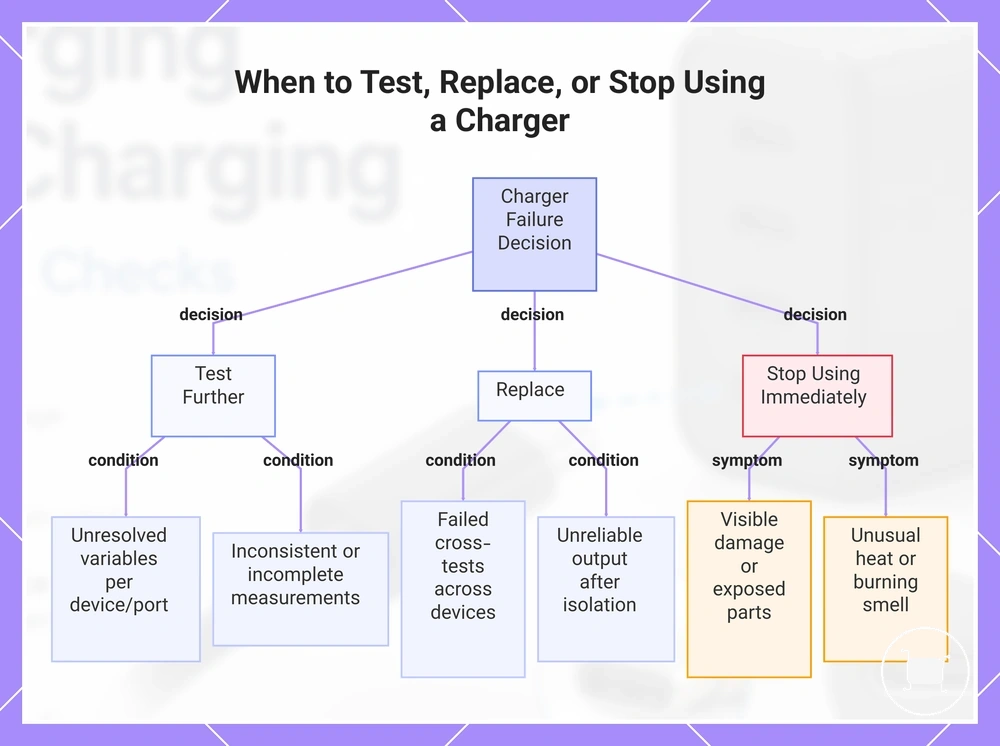
When to Test, Replace, or Stop Using the Charger
When to test, replace, or stop using the charger depends on the type of failure and whether troubleshooting continues to produce the same result. A charger that still has unresolved variables may need further testing, while repeated failure across devices can strengthen the case for replacement. Visible damage, unusual heat, and burning smell require a different response, so it is important to separate test, replace, and stop using decisions.
If basic troubleshooting no longer changes the outcome, use the checklist below to classify the next step. Focus on repeated failure, visible damage, unusual heat, burning smell, unreliable output, failed cross-tests, and measurement results.
- Test further: A charging problem appears with one device, one cable, or one port, but cross-testing has not yet isolated the cause.
- Test further: Measurement results are incomplete, inconsistent, or do not clearly identify whether the charger body is the source of the problem.
- Replace: Failed cross-tests show a repeated failure across multiple devices, cables, and known-working conditions.
- Replace: Unreliable output continues after reasonable isolation steps, and measurement results repeatedly suggest a charger-related problem.
- Stop using immediately: Visible damage such as cracked casing, exposed components, or scorch marks is present.
- Stop using immediately: Unusual heat, a burning smell, melted plastic, or similar stop-use signs appear during normal operation.
- Stop using immediately: The charger shows clear safety concerns regardless of whether charging still occurs.
If a charger fails only under limited conditions, further testing may still provide useful diagnostic results before a replacement decision is made. If repeated failure follows the charger body across devices and failed cross-tests, replacement may be appropriate. When visible damage, unusual heat, or a burning smell is present, diagnostic results become secondary to safety. In those situations, the conservative decision is to stop using the charger.
This chart shows the decision logic for classifying charger failures into test, replace, or stop-use categories based on symptoms and test results.
Using a USB-C Power Meter or Cable Tester
Using a USB-C power meter or cable tester can help isolate cable, port, or output behaviour by showing what the connection is doing during charging. A USB-C power meter can display measured voltage, current, and negotiated wattage, while a cable tester can help assess cable continuity. These readings support isolation decisions but are not a professional diagnosis.
If charging behaviour remains unclear, use the checklist below to interpret readings without overextending the conclusion:
- Check measured voltage and current to observe whether power is reaching the device under the tested condition.
- Compare negotiated wattage against expected device demand to determine whether available charger output appears limited.
- Use a cable tester to assess cable continuity and identify whether a cable test produces a repeat result.
- Repeat the same measurement across different ports to evaluate repeatability and identify port-specific differences.
- Compare output readings between known-working and problematic charging conditions rather than relying on a single measurement.
- Do not treat one power meter reading or cable test as proof of a fault because charger, cable, port, and device conditions may still require isolation.
If measured voltage, current, negotiated wattage, or cable continuity change unexpectedly between otherwise similar tests, the result may help narrow the investigation. When readings remain stable across ports and conditions, comparison against expected device demand may provide additional context for the charging outcome. Repeatability across ports can help separate a local port issue from a broader charging problem. Inconsistent readings may indicate cable, port, or negotiation instability that requires further isolation.
Physical Damage, Heat, and Safe Replacement Signs
Physical damage, heat, and safe replacement signs should stop normal troubleshooting when clear safety indicators are present. A charger with visible damage or signs of overheating may no longer be suitable for continued testing. Key stop-use signs include cracked casing, bent pins, scorch marks, burning smell, melted plastic, liquid exposure, and repeated cutting out under load.
Caution: When physical damage is visible, the priority shifts from diagnosis to safety. Cracked casing, bent pins, exposed damage, scorch marks, or liquid exposure can indicate conditions that may affect normal operation. Repeated cutting out under load may also act as a replacement signal when the behaviour continues after basic isolation steps. Stop using damaged hardware rather than attempting repair.
If a charger feels slightly warm during normal operation, that condition may differ from unsafe heat. Unusual heat combined with a burning smell, melted plastic, scorch marks, or other visible damage is a stronger warning sign than warmth alone. The safety boundary depends on damage signs and suspicious heat rather than normal warmth.
Use the checklist below when deciding whether troubleshooting should stop and replacement should be considered. For broader thermal behaviour beyond this safety boundary, see overheating symptoms.
- Cracked casing or other visible structural damage is present.
- Bent pins, damaged connectors, or exposed contact areas are visible.
- A burning smell develops during use.
- Scorch marks appear on the charger body, connector, or surrounding area.
- Melted plastic or deformation is visible.
- Liquid exposure has occurred and charger condition is uncertain.
- Repeated cutting out under load continues after reasonable isolation steps.